[PAUSE]
Last time we spoke, we stepped into a very specific, quiet room.
We acknowledged the "Off-ness."
That subtle sense that the frequency between you and your partner has shifted.
It is not a scream. It is a hum.
It is the feeling that the person sitting across from you is suddenly just a few degrees out of focus.
[PAUSE]
Now that you’ve named it, you might notice a new feeling.
It is the sudden, urgent impulse to fix it immediately.
[TRANSITION]
Welcome back.
Today we are looking at what happens right after we recognize that something is off.
Usually, when we feel a shift like this, we treat it like a crisis.
We feel a sudden pressure to act.
But I want to explore why that pressure can actually push us further apart.
[PAUSE]
When something feels "Off," our natural instinct is to grab for the dial.
We want to "work on the relationship."
We might try to initiate heavy, late-night talks.
Or we over-communicate every micro-emotion we have.
We perform grand gestures of connection.
[PAUSE]
I call this the [EMPHASIS] Fixer’s Fallacy.
It is the belief that because something feels wrong, something must be [EMPHASIS] done [EMPHASIS] right now.
It is the conviction that the discomfort itself is the problem we need to solve.
We think any action is better than just standing still while feeling disconnected.
[TRANSITION]
But I want you to consider a different perspective.
In these early stages of "The Drift," trying to "fix" it can often feel like a form of pressure.
[PAUSE]
We think we are being loving. We think we are being proactive.
But when you try to "fix" a feeling that hasn't fully revealed its source yet, you aren't actually connecting.
[EMPHASIS] You are often just trying to manage your own anxiety.
[PAUSE]
By rushing to fix the vibe, you are essentially saying to your partner, "I cannot handle the fact that we aren't perfectly aligned right now."
"I am uncomfortable with this gap."
"So, I need you to change how you feel so that [EMPHASIS] I [EMPHASIS] can feel better."
[TRANSITION]
This can create a second layer of tension.
Now, your partner isn't just dealing with whatever original drift was occurring.
Now, they are also dealing with the weight of your expectations.
They might feel the shame of "failing" to be okay for you.
[PAUSE]
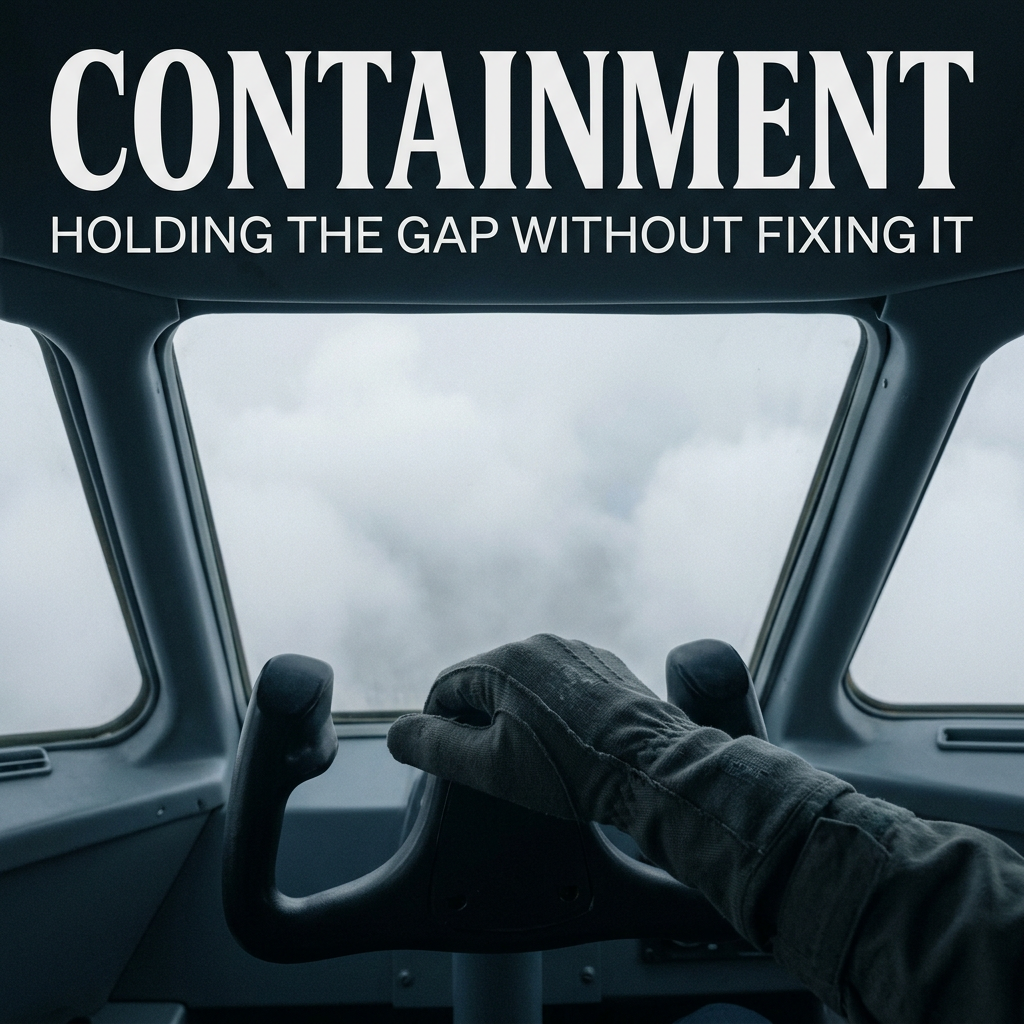
Think about a pilot.
Imagine a pilot flying through a massive cloud bank where visibility is zero.
The most dangerous thing they can do is to start yanking on the controls based on a "hunch."
Instead, they rely on containment.
They maintain a level flight path and wait for the horizon to reappear.
[EMPHASIS] This week is about containment.
[TRANSITION]
Containment is the difficult, quiet work of holding the "Off-ness."
It means sitting with that internal vibration without letting it spill over into your behavior.
Often, "doing something" is just a way to avoid "feeling something" that is difficult to name.
[PAUSE]
The industry often tells you to "communicate more" whenever you feel a gap.
But does more communication into a distorted signal actually help?
Or does it just yield louder distortion?
If you jump to a solution now, you are solving for the symptom—the immediate discomfort you feel.
You are not necessarily solving for the underlying cause of the drift.
[TRANSITION]
Containment is not passive-aggressiveness.
It is not "the silent treatment."
Containment is an anchor.
It is the active decision to stay present and kind while [EMPHASIS] refusing to panic.
It is the dignity of saying to yourself: "I feel the gap between us."
"It is uncomfortable."
"And I am strong enough to stand in that gap without demanding my partner fill it immediately."
[PAUSE]
When you contain that impulse to fix, you stop the escalation.
You prevent the "Off-ness" from turning into a fight.
Most of the friction couples experience isn't actually about the original drift.
It is often about the [EMPHASIS] reaction [EMPHASIS] to the drift.
Someone feels a shift, they panic, they push for a "talk," and the other person feels pressured.
Suddenly you are in a conflict that didn't need to be there.
[TRANSITION]
Containment creates a space large enough for the truth to eventually surface.
You can't solve a mystery while you're asking it to be a different story.
You have to let it be what it is first.
[PAUSE]
I want to speak to the person who feels like the manager of the relationship's mood.
You think that if you don't mention the "vibe" right this second, it will get worse until it is terminal.
But the goal right now is not resolution.
We are not looking for the breakthrough yet.
The goal is [EMPHASIS] stability.
[TRANSITION]
Imagine a glass of water that has been shaken.
The water is murky with sediment.
If you keep shaking it to "find the dirt," it will always stay murky.
But if the glass is left still, eventually, the sediment settles on its own.
[PAUSE]
Consider what it is like to be the person who can hold the tension.
To stay in a room with a partner who is "off" and still remain grounded yourself.
Your stability is a presence in the relationship.
It says, "I am a safe place for you to be human, even when we aren't perfectly in sync."
[TRANSITION]
The tension here is significant.
The impulse to reach out and close the distance is a strong one.
But for now, the gap is just the gap.
We are keeping the plane level in the clouds.
We are waiting for the air to clear before we decide which way to turn the wheel.
[PAUSE]
There is an internal shift that happens when we stop trying to fix the static.
We start to see the partner in front of us, rather than the problem we want to solve.
I’m glad you’re here.
Talk soon.
[PAUSE]