(Intro music: Low, steady warmth. A cello or a soft synth. Something that feels grounded and rhythmic.)
[PAUSE]
ZONE 1: ENTRY
You are a woman who knows how to move through the world.
Whether you are navigating a boardroom, managing a team, or holding the emotional architecture of your family together in a crisis, you are recognized for your precision. People look to you because you can identify a problem, find the right words for it, and construct a bridge toward a solution. You are articulate. You are self-aware. You have likely spent years in the pews of personal development.
And yet... [PAUSE] ...in your own kitchen, or lying three inches away from your partner in the dark, you are frequently struck dumb.
You find yourself in those moments where you can feel something—a weight, a shift, a specific kind of coldness—but when you open your mouth to describe it, your voice falters. You reach for the tools you’ve always used, but they feel like they’ve turned to sand in your hands.
You know exactly how to speak everywhere else. But here, in the space between you and the person you love most, you find yourself saying, "Never mind. It’s fine. Forget it."
[TRANSITION: Sound lowers slightly, focusing the listener’s attention.]
ZONE 2: RELEASE
If you have been feeling a growing sense of frustration—or maybe a deep, bone-weary fatigue—from these moments, I want you to take a breath.
There is a specific kind of internal pressure that builds when you are a highly capable person who suddenly feels incompetent in your most important relationship. You start to wonder if you’re losing your edge. You wonder if you’ve actually been "bad at communication" all along, despite what your professional life tells you.
But what if the silence isn't a lack of intelligence? What if the reason you can’t find the words is simply that the words for what you are experiencing haven’t been given to you yet?
It is common to believe that if we are smart enough and we care enough, we should be able to explain what’s happening. But you are trying to navigate a sprawling, complex emotional forest with a map that has the "You Are Here" sticker missing. You know you are somewhere. You can feel the dampness of the air and the unevenness of the ground. But because that "somewhere" has no name, you cannot tell anyone how to find you.
It’s not a failure of your intellect. It’s a vacancy in the language.
[PAUSE]
ZONE 3: INSIGHT
When we feel the distance growing, we tend to reach for the words we have available. Words like "lonely." Or "disconnected." Or "unseen."
The problem is that these words are thin. They are generic. Using them to describe the reality of your midlife relational experience is like trying to describe a cathedral using only the word "building."
It’s technically true, but it misses the entire point. It misses the vaulted ceilings, the stained glass, the way the light hits the floor at 4 PM, and the echoing silence of the halls.
When you say, "I feel lonely," and your partner points out that you just spent the entire weekend together, you have no rebuttal. Within the world of the word "lonely," he is factually correct. You were in the same room. You ate at the same table. You watched the same movie.
But you also know that the "togetherness" felt like two people standing on opposite sides of a thick pane of glass. You could see him, but you couldn't feel his heat. You were together, but the air between you was dead.
Because you don't have a precise name for that "glass," or for the specific brand of isolation that occurs when two people are speaking the same language but living in different worlds, you eventually give up the effort of translation.
[EMPHASIS] This is what I call the "Never Mind" Tax.
It is the silent withdrawal of your true self because the cost of translation has become too high. Every time you start a sentence, realize it’s going to take four hours of explaining—and that you’ll probably still be misunderstood—and then decide to just tuck that feeling back into your pocket... you are paying the tax.
The tax is paid in small increments. A "Never mind" in the car. A "Forget I said anything" before bed. A "It’s not worth the fight" on a Tuesday afternoon.
And after a while, you realize you are exhausted. But it’s not the kind of tired that sleep can fix.
This is "Translation Exhaustion." It’s the bone-weary fatigue that comes from trying to turn a visceral, lived experience into a language that hasn't been invented yet. You are doing the work of an explorer, a linguist, and a negotiator all at once, while simply trying to decide what to have for dinner.
[PAUSE]
There is a ghost in the room. It isn’t a person, and it isn’t a mistake you made. The ghost is the unnamed experience itself. It sits between you at the table, making the air heavy and the conversation brittle.
You feel it in your body long before you can think to speak. It’s a tightening in the chest. A closing of the throat. A sudden, sharp desire to be in a different room.
Communication experts tell you to use "I" statements. They tell you to "just be vulnerable." But no amount of "I" statements can fix a lack of architectural support. You can say "I feel..." until you are blue in the face, but if the word that follows doesn't capture the vastness of the cathedral you are standing in, you will still be standing there alone.
We have been taught to fear the silence. We’ve been told that if there is a gap, we must fill it immediately with "fix-it" projects or frantic explanations. We think we have to build the bridge while we are still drowning in the water.
But when we rush to fill the gap with the wrong words, we actually make the distance feel more permanent.
[PAUSE]
ZONE 4: LANDING
This week, we aren't fixing the bridge. We aren't even looking for the tools to build it yet.
We are simply acknowledging that the reason you feel so lonely in your own story is that you have been forced to be your own sole witness. You have been carrying the weight of an experience that has no shared vocabulary.
That weight—that unnamed, unshared, untranslated reality—is what is breaking your heart. It’s not necessarily the relationship itself that is the problem; it is the inability to be known within it.
Take a moment to let that land.
You are highly articulate, yes. But you are currently unheard—even by yourself—because the words you’ve been given don’t fit the life you are actually living.
Stop blaming your intellect for the silence. Stop blaming your partner for not hearing a language that hasn't been spoken yet.
For now, just look at the space between you. Look at the "between." And allow yourself the dignity of saying:
"I don't have the words for this yet. And that is why I am so tired."
[PAUSE]
(Outro music: The cello returns, fading out slowly.)
EPISODE NOTES
Summary In this episode, we explore why even the most articulate and self-aware women often find themselves speechless when trying to describe the growing distance in their relationships. We name the specific fatigue of "Translation Exhaustion" and the hidden cost of the "Never Mind" Tax.
Key Takeaways
- Relational confusion is often not a lack of intelligence, but a lack of precise vocabulary for complex midlife experiences.
- Generic words like "lonely" or "disconnected" often fail to capture the visceral reality of standing on the other side of a "pane of glass" from a partner.
- The silence we feel in our relationships is frequently the result of an unnamed experience sitting between two people like a ghost.
Quotes
- "You are trying to navigate a sprawling, complex emotional forest with a map that has the 'You Are Here' sticker missing."
- "The 'Never Mind' Tax is the silent withdrawal of your true self because the cost of translation has become too high."
- "You are not 'bad at communication.' You are simply living inside the language you don't have yet."
Timestamps
- 00:00 Set the Room: The articulate woman struck dumb in her kitchen.
- 03:20 Revelation: Finding that your "togetherness" feels like a pane of glass.
- 07:45 Story+Meaning: Defining the "Never Mind" Tax and Translation Exhaustion.
- 12:15 Integration: Recognizing the "between" without rushing to fix it.
Call to Action This week, simply notice the moments where you reach for a word and find it insufficient, and allow yourself to let the silence sit without judging it.
Links [No links referenced in the script]
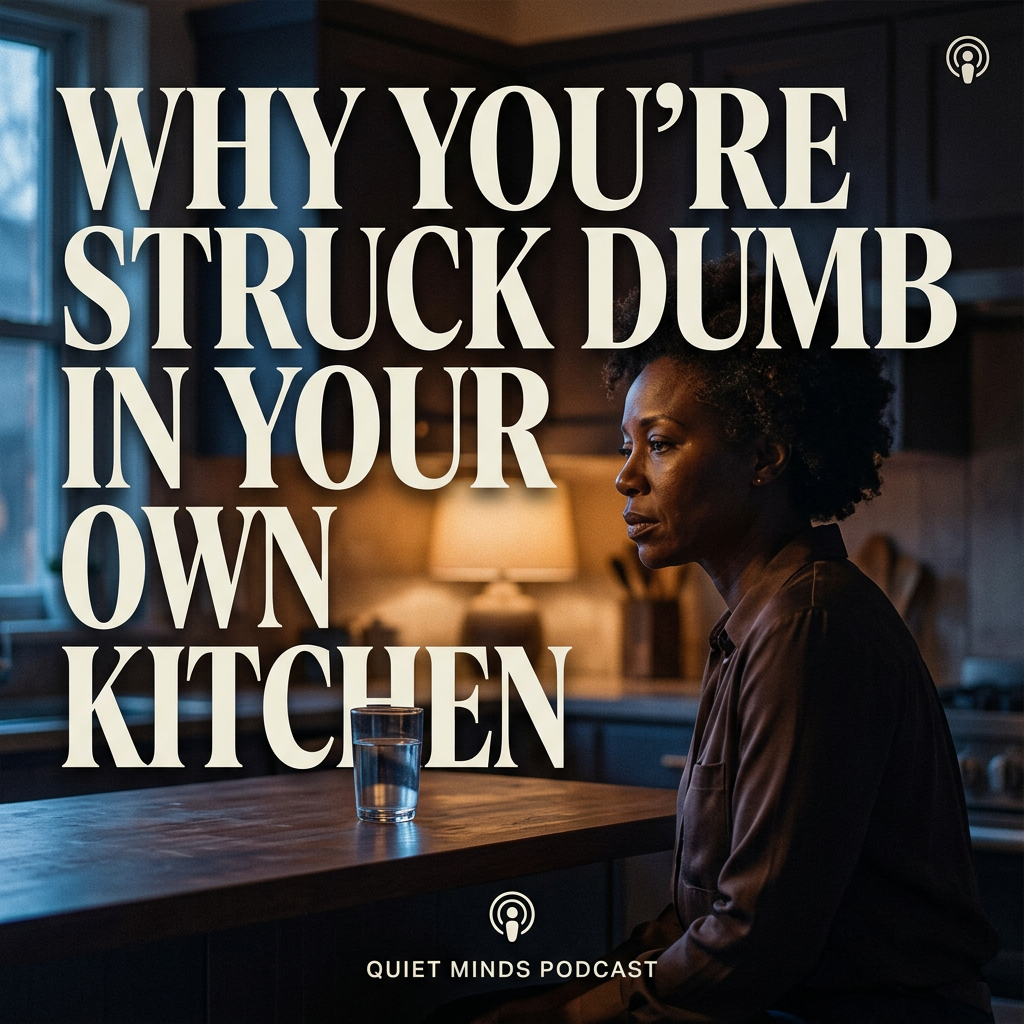
IMAGE PROMPT A cinematic, close-up shot of a woman in her late 40s with deep mahogany skin, sitting at a dark wood kitchen table at dusk. She is looking slightly off-camera with an expression of quiet, heavy contemplation. In front of her is a single glass of water on the table, catching a sliver of blue light from a nearby window. The atmosphere is thick with shadows and a sense of stillness. The color palette is moody blues, deep browns, and a soft, amber glow on her face. The composition is intimate and grounded, focusing on the weight of the silence in the room.
Keywords relational clarity, midlife transition, communication barriers, emotional vocabulary, relational isolation, translation exhaustion, the never mind tax, relationship silence
Word Count: 1,642 words Title: Why You’re Struck Dumb in Your Own Kitchen Entry Mode: Direct Release Mode: Decompression Insight Mode: Narrative Landing Mode: Statement Metaphor Type: Spatial Stage Compliance Notes: This script strictly follows the Week 1: Clarity blueprint. It identifies the problem of "Translation Exhaustion" and the "Never Mind" Tax without offering solutions, frameworks, or advice. It maintains the tension of the unnamed experience and centers on recognition. it avoids all prohibited language and follows the dignity floor by focusing on the systemic gap of language rather than blaming individuals.