[START_PODCAST]
(Intro music—something sparse, rhythmic, and slightly heavy. It holds a lingering note that doesn’t quite resolve. Fade to low.)
[PAUSE]
You likely know the feeling of the drive home. Not the drive itself, but the transition. That twenty-minute window where you are shifting from being the person who gets things done, to being the person who manages the home. [PAUSE] Maybe you’re sitting in the car, the engine is off, and you stay there for three minutes longer than you need to.
It’s not because you don't love the people inside. It’s because you are checking the gauges. You are assessing the relational field before you even step through the door. Is the mood low? Is the kitchen a mess? Who needs to be buffered? Who needs to be handled?
In your work, they call this leadership. They call it being high-performing. In your marriage, you’ve probably just called it being a good partner.
But lately, there is a question that has been humming in the background of all that competence. It’s a question that doesn’t have a name yet, but it feels like a weight.
The question is: [EMPHASIS] Why isn't my extra effort creating more closeness?
[TRANSITION]
For years, your default setting has been resilience. When things feel strained, you do what you’ve always done—you increase your output. You think: If I can just be a little more patient, a little more organized, a little more supportive, we will finally get over this hump.
You’ve treated your relationship like a project that can be optimized. If the bridge is sagging, you provide more human scaffolding. You become the load-bearing wall.
And from a distance, it looks like it’s working. The kids are fed. The bills are paid. The social calendar is full. The crisis is avoided.
But there is a sobering realization that comes after years of being the "strong one." It’s the realization that in the economy of a relationship, your over-performance creates a deficit in your partner.
[PAUSE]
I want you to imagine a room. The room is sealed tight, and for some reason, it is slowly losing oxygen.
Your natural instinct—the one that has made you successful in every other arena of your life—is to work harder. You try to find the leak. You breathe deeper. You move faster. You try to sustain the system through sheer force of will.
But you are operating in a vacuum. And in a vacuum, the harder you work, the more oxygen you consume. Every "fixing" move you make, every "doing" task you take on to keep things afloat, actually uses up the very air the relationship needs to breathe. This is the oxygen mask in a vacuum. You are working harder and harder to sustain a system that is actually designed to fail the more effort you put into it.
[TRANSITION]
This brings us to a concept we need to name: [EMPHASIS] The Efficiency Trap.
Because you are so competent, you have become a barrier to the very connection you crave.
Think about how this actually plays out on a Tuesday night. You notice the tension in your partner’s shoulders, so you "soften" your tone before they even say a word. You anticipate a conflict about the weekend schedule, so you just handle it yourself—quietly, efficiently—before it can become a conversation. You track the emotional climate of the house like a meteorologist, adjusting the thermostat so no one else has to feel the chill.
In your mind, you are protecting the relationship. But in reality, you are quietly enabling the distance.
You aren’t solving the problem. You are absorbing the consequences of the problem so that your partner never has to feel them. And because they don't feel the consequences, they don't feel the need to change. They don't have to grow into the space you are already occupying for them.
[PAUSE]
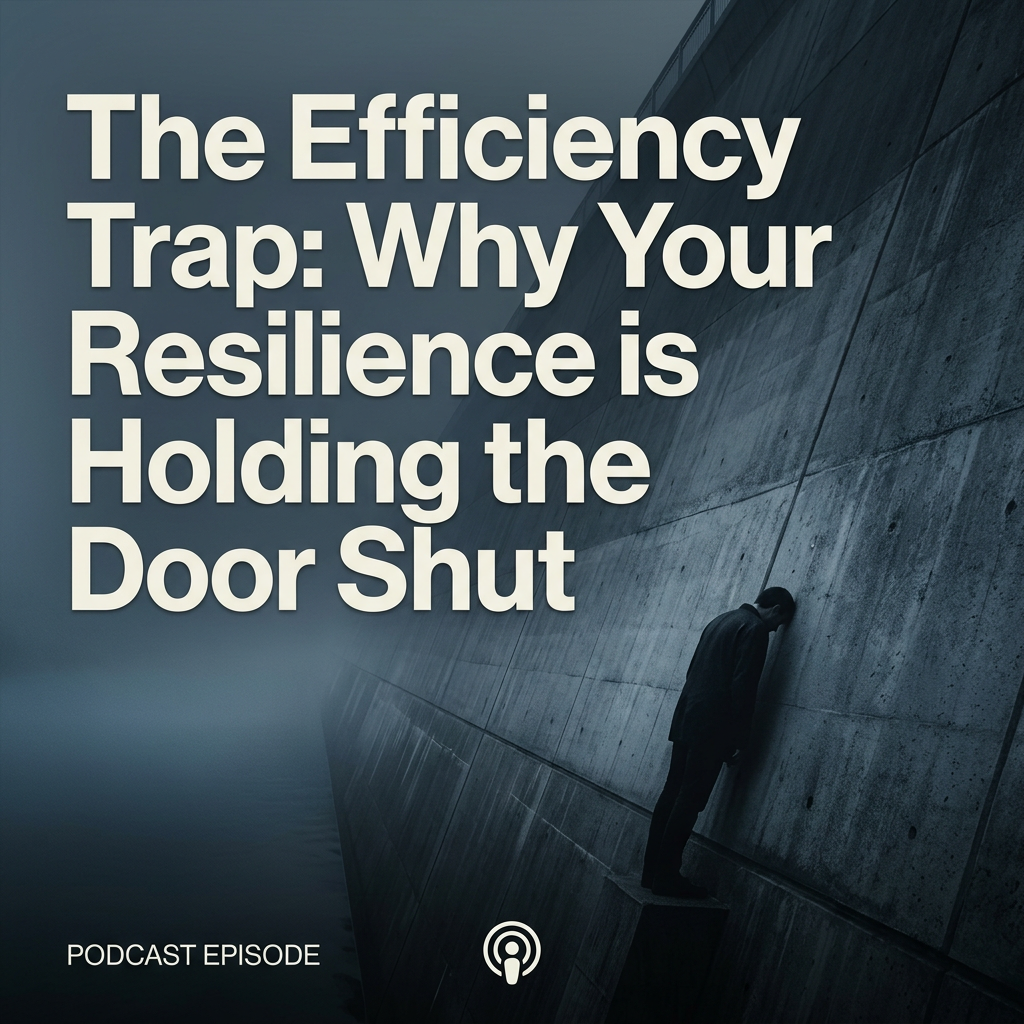
Imagine yourself as an overflowing dam of responsibility.
Behind you, there is a massive wall of water. It’s the collective chores, the emotional labor, the social planning, the conflict resolution, the "remembering." You are holding that wall back, 24 hours a day.
You think you are protecting the valley below from a flood. That is the story you tell yourself. But look at the valley. Because the valley never gets wet, it never learns how to build its own irrigation systems. It never learns how to handle the water.
By being the "strong one," you have inadvertently trained your partner that their presence, their effort, and their responsibility are optional.
Your resilience is not supporting the connection; it is eroding it.
Every time you "step up" to cover for a lack of engagement, you move one step further away from a partnership of equals. You are no longer a partner. You have become a buffer.
[TRANSITION]
Now, usually, when someone hears this, the first instinct is to find a new strategy. You want to know how to "fix" the over-functioning. You want a technique for "setting boundaries" or a better way to "communicate."
But we have to be very careful right here. [EMPHASIS] Stop.
Any new "effort" you apply right now—any new tool you try to use to fix this—will be filtered through the same old lens of over-functioning. If you try to "fix" the fact that you do too much, you will just end up "doing" the fixing. You will manage the recovery just as efficiently as you managed the problem.
And we will be right back where we started.
For now, the only thing to do is to sit with the weight of the dam.
Feel the pressure of the water against your back. Realize that for years, you have been horizontal. You have been acting as the bridge between where you are and where you want to be. And the reason you are so tired—the reason you feel that "functional but drained" hum in your bones—is because you were never meant to be the infrastructure.
You were meant to be a person.
Your extra effort hasn’t failed because you aren’t doing enough. It has failed because you are doing too much.
The loop is self-reinforcing: your strength allows them to stay disengaged; their disengagement requires you to stay strong.
[PAUSE]
To break this, we have to first look at the tool in your hand. Your reliability. Your grit. Your ability to solve things before they break.
We have to admit that for this specific lock, it is the wrong key. There is no more "extra" left to give. And even if there were, it wouldn't bring you closer. It would only make the distance more comfortable for the person you love.
[PAUSE]
You may notice as you listen to this that there is a part of you already looking for the next step. A part of you that wants to know how to let the water through without drowning.
Don't go there yet.
Stay with the awareness of the weight. Stay with the image of the bridge.
Notice the way your body feels when you realize that the harder you try, the further away the connection feels. [PAUSE] Notice the silence in the car before you turn the key.
That silence isn't a problem to be solved. It’s the sound of the old toolkit finally hitting the floor.
(Outro music—the same sparse, rhythmic track from the beginning, but shorter this time. It ends on a single, un-sustained beat.)
[END_PODCAST]
episodeNotes: The "strong" partner often believes their extra effort is the only thing keeping the relationship alive. This episode explores why high-functioning resilience can actually become a barrier to intimacy. By absorbing the consequences of relational gaps, the over-functioning partner creates an "efficiency trap" that prevents their partner from engaging.
Key Takeaways:
- Over-performance in a relationship creates a corresponding deficit in the partner’s engagement.
- High competence can act as "structural interference" that prevents the other person from growing into their shared responsibilities.
- The harder one partner tries to "fix" a vacuum of connection, the more they consume the relational oxygen needed for partnership.
Quotes:
- "In the economy of a relationship, your over-performance creates a deficit in your partner."
- "You are no longer a partner. You have become a buffer."
- "Your extra effort hasn't failed because you aren't doing enough. It has failed because you are doing too much."
Timestamps: 00:00 - The Transition: Checking the Relational Gauges 02:15 - The Oxygen Mask in a Vacuum 04:45 - The Efficiency Trap and Enabling Distance 07:30 - The Dam of Responsibility 11:00 - Why "Trying Harder" Sustains the Problem
Call to Action: For more insights on the cost of relational strength, visit our resource library in the series hub.
imagePrompt: A wide-angle, cinematic shot of a single, dark-toned figure leaning against the massive, cold concrete wall of a dam. The figure is small compared to the scale of the structure. The water above is not visible, but the sheer scale of the wall suggests a heavy, invisible weight. The lighting is dim and atmospheric, using a palette of slate blue and charcoal. High contrast, focusing on the texture of the grey concrete and the weary posture of the person.
keywords:
- Over-functioning
- Relational exhaustion
- The Efficiency Trap
- High-functioning partners
- Emotional labor
- Relational patterns
- Strength as a barrier
entryMode: scene releaseMode: decompression insightMode: contrast landingMode: image metaphorType: physical wordCount: 1650 stageComplianceNotes: Content avoids any advice or redirection toward Week 3 reframes. It stays entirely within the containment of the current problem, focusing on why effort fails without offering a new method of effort. Titles are unique from siblings and frame-specific. Termination occurs correctly after the landing prose.