(Intro Music: Warm, low-frequency cello or a steady, grounding beat that fades slowly into the background)
[PAUSE]
Zone 1: The Entry
You’re sitting in the car. It’s that twenty-minute drive home after dinner with another couple, or maybe just the drive back from the grocery store. The radio is off. The kids aren't in the back seat anymore—or if they are, they’re buried in their phones. And for the first time in twenty years, the silence between the two of you doesn't feel like a rest. It feels like a weight. [PAUSE] You find yourself looking out the side window at the passing streetlights, and there’s this sharp, sudden prick of anxiety in your chest. You wonder: Did we run out of things to say? Is this what the beginning of the end looks like?
[TRANSITION]
Zone 2: The Release
I want you to take a breath right there, in that imaginary passenger seat. [PAUSE] What you’re feeling—that heavy, vibrating stillness—is one of the most common, yet least talked about, thresholds in a long-term relationship. It’s a specific kind of midlife weather. And if you feel a frantic urge to reach out and say something, anything, just to break the tension... I want you to know that that impulse is completely understandable. You aren't failing. You’re navigating a cooling of the air that happens to almost every high-functioning couple who has successfully built a life together. You are simply in a new season, and your internal compass is still trying to find North in a landscape that has changed.
[TRANSITION]
Zone 3: The Insight
We’ve been talking in this series about the shift from "Fireworks" to the "Fireplace." The move from the explosive, high-vibration energy of building—the careers, the kids, the spectacle of a life in motion—to something steadier. But there is a middle ground we have to cross first. And it’s a place I call the "Smoke." [PAUSE]
In the first half of your relationship, you were probably experts at the "Spectacle." You had what I call a Relational Repair Kit. Think about it. Whenever the energy dipped or the connection felt thin, you knew exactly which tool to grab. You scheduled the "big" trip. You initiated a four-hour marathon conversation about "the state of the union." You pushed for a high-intensity date night. You struck matches, and you lit rockets, because in that season, keeping the sky bright was the goal. It worked. It kept the vibration high.
But now? [EMPHASIS] You reach for the old kit, and the tools feel strangely light.
You try to initiate that deep talk, and it feels forced. You go on the trip, but the silence follows you to the hotel room. This is the moment where the Impulse to Fix becomes a liability.
See, for high-achieving, high-functioning people—which I suspect you are—emptiness is almost always coded as failure. You have spent two decades being productive together. You have managed budgets, navigated family crises, and coordinated the thousands of moving parts that constitute a modern life. You are experts at solving. [PAUSE] So, when you look across the kitchen island and you don’t feel that old electricity, your brain does what it was trained to do: it treats your relationship like a broken appliance.
You move into what we call the Diagnostic Gaze.
You start troubleshooting your partner. You ask, "What’s wrong?" but your tone sounds like you’re asking a car engine why it’s knocking. You look for a malfunction. You might even try to spark a high-drama debate—not because you’re actually angry about the dishes, but because a fight creates "noise." And noise feels more like "connection" than this quiet does. [PAUSE] But those are phantom sparks. They are attempts to relight damp fuses that have already done their job.
There’s a dynamic that often happens here that we can think of as a Thermostat Mismatch.
Maybe you’re the one who feels the cooling air and panics. You feel the temperature drop, so you crank the heat. You demand more attention, more "vulnerability," more something. And your partner? They feel that heat not as an invitation, but as pressure. They feel like they’re being audited. So they retreat further into the shadows, which makes you panic more, which makes you crank the heat higher. [PAUSE] The more you try to "fix" the climate, the more erratic and uncomfortable the climate becomes.
You find yourself trapped in a cycle of performance. You’re trying to act like a couple that is "thriving" by a standard of intensity that belongs to people you aren't anymore. [EMPHASIS] You have outgrown the fireworks, but you haven't yet learned how to sit by the fire.
[TRANSITION]
This week, our only goal is Containment.
Containment is the uncomfortable, necessary act of holding the tension of this cooling relationship without rushing to strike another match. It is the courage to stay in the room when the lights are low. [PAUSE] I often tell couples that a fireplace cannot be built while the fireworks are still exploding. The smoke has to clear first. And right now? You are in the smoke.
The weight you are feeling—that stillness that feels like it’s pressing against your chest—isn't the end of your story. It is the Containment Phase. It’s the space between who you were as a couple and who you are becoming. And that space cannot be bypassed. If you try to "fix" the relationship too early, you will fix it into an old shape. You’ll force it back into a version of "intensity" that you are actually too tired to maintain.
[PAUSE]
Zone 4: The Landing
You don't need a new set of tools today. You don't need a "communication hack." What you need is to recognize the "Fixer’s Exhaustion" you’ve been carrying. [PAUSE] That bone-weary realization that you cannot manufacture a spark that isn’t there.
Tonight, or tomorrow, when that silence happens again—and it will—I want you to just notice the urge to reach for the old rockets. Recognize the fear that rises when the conversation ends and neither of you picks it up. Your relationship isn't a problem to be solved; it’s a system in recalibration.
[PAUSE]
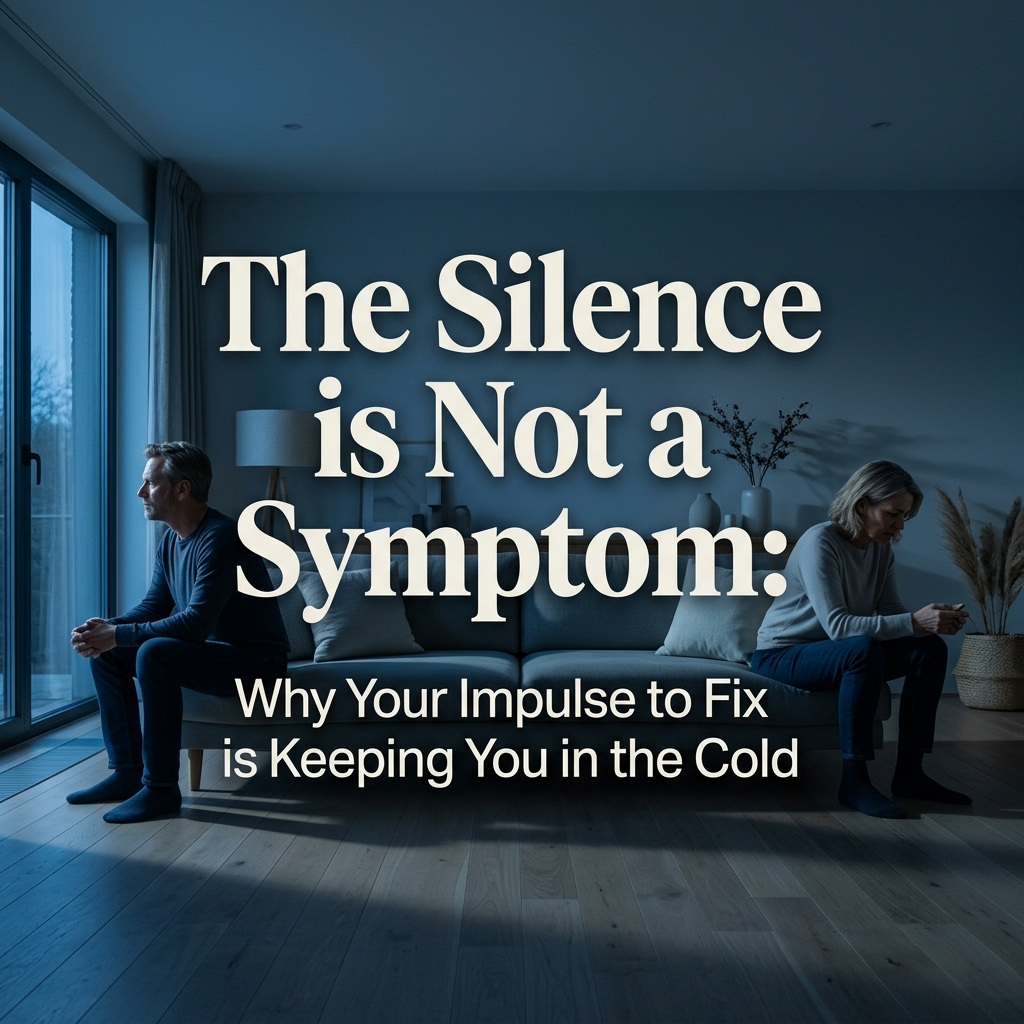
The house is quiet. The dishwasher is humming its regular cycle in the kitchen. You’re both in the same room, but you’re miles apart in the stillness.
You feel the impulse to ask the diagnostic question. To ask "what's wrong" one more time.
And instead, you just stay there. You sit in the cooling air. You let the silence be exactly as heavy as it is.
The evening continues.
(Music: Fades in slowly—low, steady, and lingering. No resolution, just a sustained note that eventually trails off into silence.)