You are sitting in the same room where you’ve spent a thousand evenings, but the air between you has changed. The house is quieter, the logistics of the day are settled, and the urgent coordination that defined your shared life for twenty years has finally slowed down. In the silence, you feel a drop in temperature. You look at your partner and realize you aren't sure what to say, and that lack of signal registers as a deep, internal alarm.
It makes complete sense that this shift feels like a threat. For decades, your connection was fueled by a high-intensity broadcast—the coordination of careers, the management of children, and the constant output required to build a life. You have been conditioned to believe that if the energy isn't surging, the system is failing. It is a heavy thing to carry, this feeling that you are suddenly standing in a cold room with someone you’ve loved for half your life.
For years, your brain functioned at a high RPM, tracking every movement and logistical fire. When that frequency suddenly drops, your internal threat detection—the amygdala—doesn't register "rest." It registers a loss of power. Your body reacts with a restless urge to fix a problem or strike a match, simply because it hasn't learned how to process a steady, quiet current.
Think of your relationship as an electrical system that has spent twenty years on a high-voltage transmission. In those early "Fireworks" years, the energy was spectacular, but it was inefficient. Like an open broadcast in a storm, much of that heat was lost to the wind. You had to keep the voltage high and the signals loud just to stay connected. You were confusing the crackle of the transmission for the strength of the bond.
What you are entering now is a transition in how your shared life holds energy. You are moving from a state of constant transmission to a state of thermal mass.
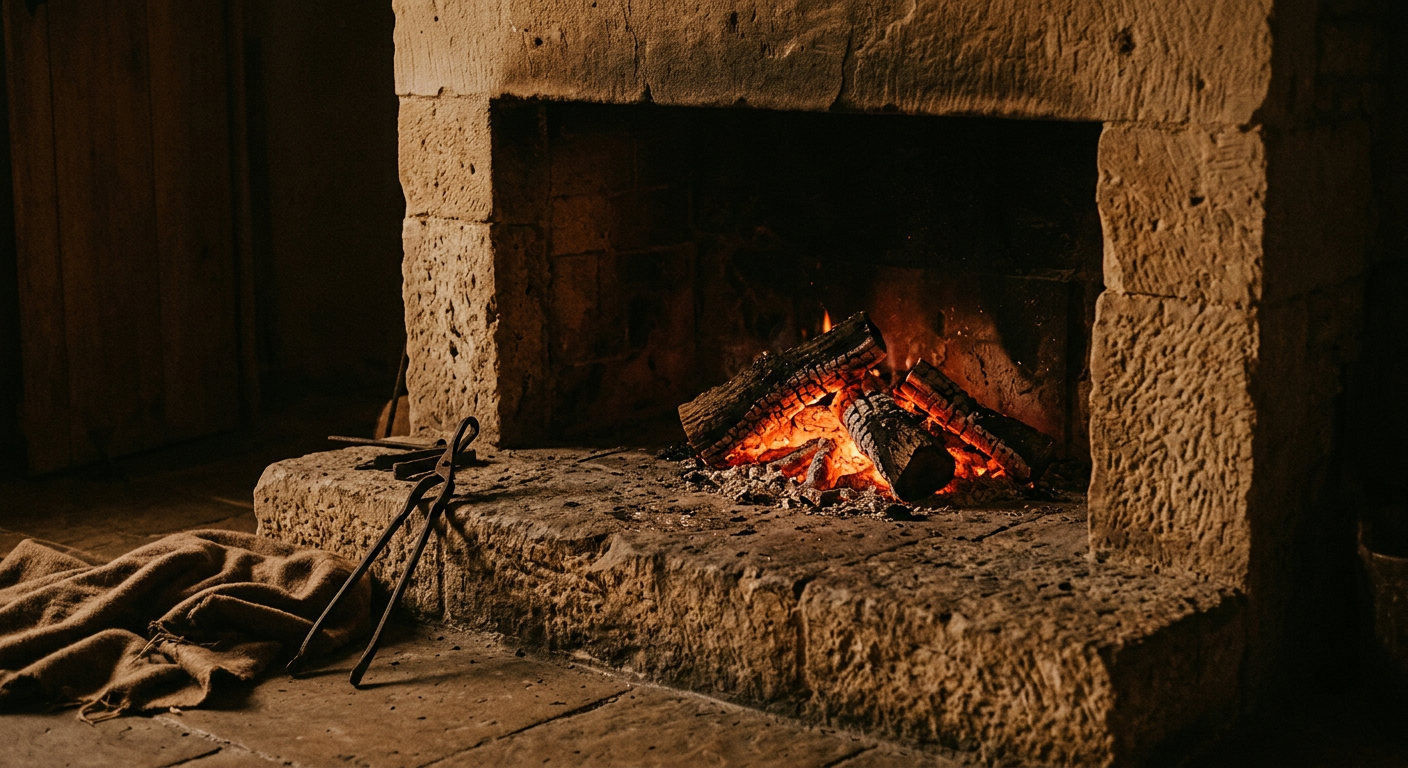
In the previous season, you were a builder, and builders are evaluated by their output—by the visibility of the flame. But in this new season, the heat you’ve generated over two decades is no longer dissipating into the atmosphere. It is being absorbed by the stones of the relationship itself.
You aren’t "running out of things to say." You are finally reaching a stage where you don’t have to perform to exist. The tension you feel—that itch to start a debate or solve a non-existent problem—is the shivering of a system that is still trying to be "on fire" to feel safe. You are misinterpreting the steady radiance of the hearth as the recession of the light.
But a spark, while brilliant, cannot keep a room warm through a long winter. Only a hearth can do that. You are moving from the exhaustion of the performance to the rest of the presence.
This is not the fire going out. It is the heat moving into the stone.