[SERIES INTRO MUSIC - LOW TENSE CELLO, GROUNDED, SLOW TEMPO]
[00:00] [VOICE: Calm, steady, speaking with the weight of someone who is in the room with you.]
Hello. [PAUSE]
Last time we were together, we named something that usually stays hidden in the static of a busy life. We talked about being "relationally overdrawn." We looked at that heavy, bone-deep exhaustion not as a personal failure of your character, but as a structural reality of your life.
[TRANSITION]
Most of us have spent the last few months—maybe the last few years—treating our lives like a math problem that won’t balance. We’ve been convinced that if we could just find the right variable to cut, or the right efficiency to add, the equation would finally resolve.
We look at the calendar. We look at our sleep hygiene. We try "saying no" more often. But lately, even that "no" feels like a paper dam holding back a structural flood. [PAUSE]
And so, we do what we’ve always done. We reach for the toolkit. We look for a way to work the problem.
[TRANSITION]
[02:15]
This is where we have to be very careful.
When we feel this overdrawn—when the demands of aging parents, and growing children, and a plateauing career, and a long-term partnership all hit their peak complexity at the exact same time—our natural instinct is to reach for tools designed for a much simpler life.
We try to apply "Time Management" to "Grief Management." We try to apply "Conflict Resolution" to "Systemic Overload." We think that if we just find the right words for the "Big Talk" with our partner, or the right meditation app, the lights will stay on.
But there’s a quiet, hard observation we have to make here. One that’s difficult to sit with.
[EMPHASIS] It is very possible that you are trying to fix a structural collapse with a renovation budget. [PAUSE]
[04:00]
When you realize you’re in the red, the impulse is to "earn" your way back to black. You double down on effort. You buy the planner. You schedule the date night. You try to bypass the discomfort of the debt by doing something.
But the exhaustion remains. And it remains because those actions are often just attempts to avoid the weight of what is actually happening.
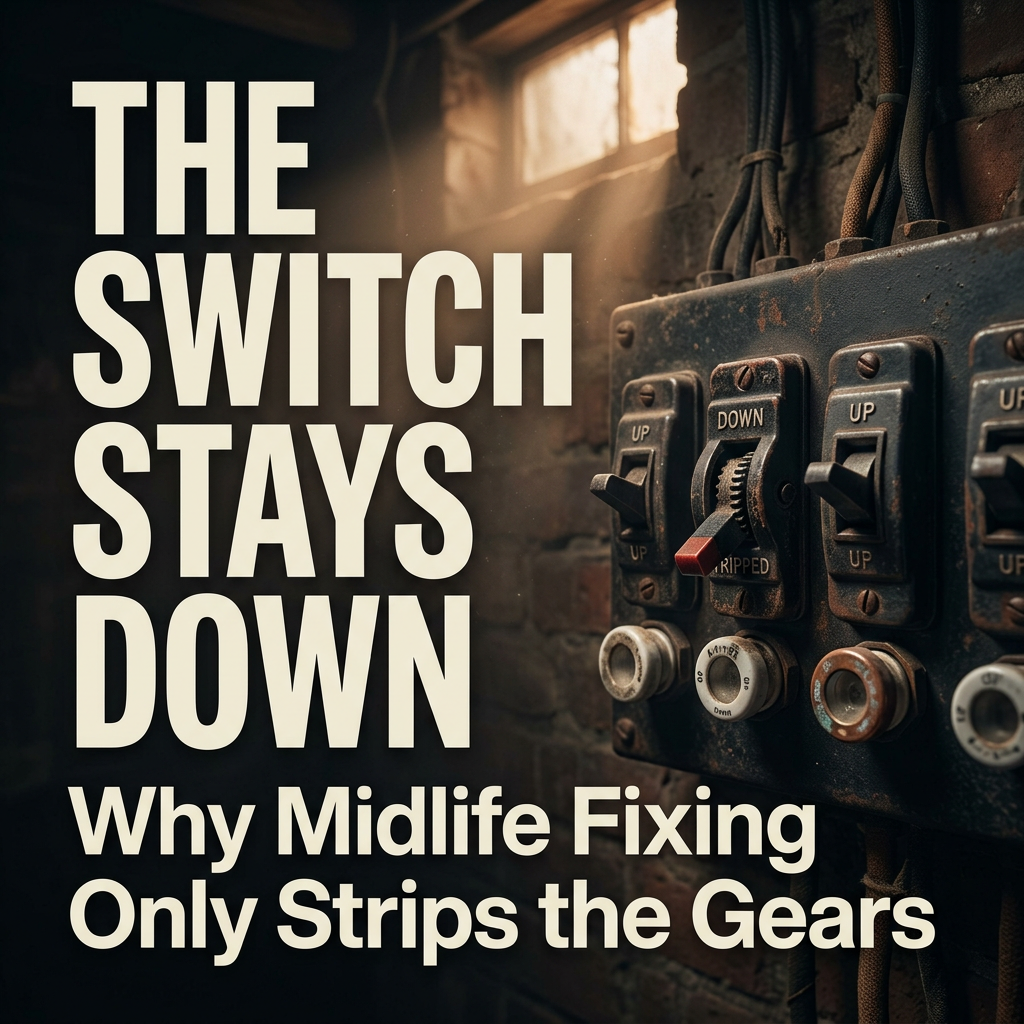
Think about the wiring in your life. [PAUSE]
Imagine a house built in the 1950s. At the time, the wiring was excellent. It was designed to handle a few lamps, a toaster, a radio. It was perfectly suited for that world.
But your life isn't that world anymore. You’ve added a Tesla charger. You’ve added central AC, a smart kitchen, a home theater. In relational terms, you’ve added the immense, simultaneous complexity of midlife.
When the breakers trip, you don’t need a more expensive lightbulb.
[06:00]
You need to acknowledge that the current wiring simply cannot carry the load.
The strategies you built in your twenties and thirties—the "pushing through," the "figuring it out," the "taking one for the team"—those were the 1950s wiring. They got you here. They worked for a long time.
But now, they are the very tools that are stripping the gears.
[TRANSITION]
[07:30]
When the system is this overloaded, your nervous system enters a state of "high-alert fragility."
You might notice that you’re hyper-aware of every single demand—the way the teenager slams the door, the specific tone of a work email, the silence of your partner at dinner—yet you feel paralyzed by the inability to meet any of it with the quality of presence you used to have.
This isn't because you've lost your edge. It’s because the "Account" you are drawing from was never designed to fund this many simultaneous high-stakes investments at once.
[09:00]
If we try to fix this prematurely, we often end up "leaking" our remaining energy into frantic, low-impact actions. We try to solve the distance in our marriage on a Tuesday night when we are already running on fumes. We try to "fix" our parents' declining health with a spreadsheet.
And all we do is deepen the deficit.
[TRANSITION - MUSIC SHIFTS TO A SINGLE HOLDING NOTE]
[10:30]
Containment isn't a strategy to change the situation. It’s the act of holding the tension of the "unsolved."
It’s the recognition that your partner’s distance, or your mother’s health, or your own sense of vanishing... these are not problems to be "solved" by next week.
They are realities to be carried. [PAUSE]
When you name the load without trying to drop it, you move out of that reactive panic and into a state of heavy, honest clarity. The weight you feel is not an illusion. It is the literal gravity of midlife complexity.
And you cannot outrun gravity.
[12:15]
We are staying here for a moment. We are letting the "to-do" list sit cold. We are looking for the edges of the room and defining the shape of the debt.
This is not a failure of your will. It is the limits of your architecture. [PAUSE]
[TRANSITION - MUSIC FADES INTO NEAR SILENCE]
[14:00]
The house is dark because the breakers have tripped.
You can feel the heat in the walls where the wires have been working too hard for too long.
The impulse to reach for the switch is there—the urge to flip it back on, to try one more time, to force the lights to stay bright for just one more evening.
But tonight, the switch stays down.
There is only the sound of the house settling in the dark, and the weight of the air, and the slow, hot hum of the wiring behind the plaster.
[15:30] [PAUSE]
The heat is still there in the walls.
The dark is still there in the room.
The switch stays down.
[FADE TO SILENCE]