[TRANSITION - Soft, grounded opening]
You are standing in your kitchen, late at night, and the house is finally quiet. But the air around you still feels heavy with the static of everything that happened today. You can still hear the echo of your teenager’s sharp tone, the fragile hesitation in your father’s voice on the phone earlier, and the unspoken tension that sat between you and your partner during dinner. [PAUSE]
You are physically still, but your internal grid is hummed to a fever pitch. It feels like you’re trying to broadcast a clear signal through a storm that never ends. You’ve been telling yourself that if you could just find a better way to manage the schedule, or if you could finally get that one "big conversation" right, the noise would stop. You’ve been treating this exhaustion like a technical glitch in your character.
[EMPHASIS] But I want to suggest something different today.
[TRANSITION - Release Zone]
What you are carrying right now is not a sign that you are failing. It is not a sign that your relationship is dying or that you’ve lost your edge. It actually makes perfect sense that you feel this frayed. You aren't "weak" for feeling overwhelmed by the sheer volume of emotional current running through your life. You are simply a system that has reached its absolute limit of transmission. [PAUSE]
[TRANSITION - Insight Zone]
In the earlier chapters of your life, things were relatively linear. You were building a career, establishing a home, proving your worth. Back then, your relational world was simpler. You had a few key channels to monitor, and if there was a problem, you could usually turn up the volume of your effort to fix it. The strategies that worked then were "Push Through," "Figure It Out," and "Deliver."
But midlife has changed the frequency. [EMPHASIS] You aren't just a person anymore; you’ve become the central switchboard for an entire relational ecosystem.
You’re managing the fading autonomy of parents who are losing their grip on their own lives, while simultaneously navigating children who are finding theirs with a confusing, high-voltage intensity. And in the middle of all that, you’re trying to maintain a long-term partnership that has moved from the bright spark of discovery into the heavy, daily labor of maintenance.
The problem is that you’re still trying to use those old, blunt tools—the "fix-it" mindset and the "do more" energy—on problems that actually require emotional presence and deep nuance. [PAUSE]
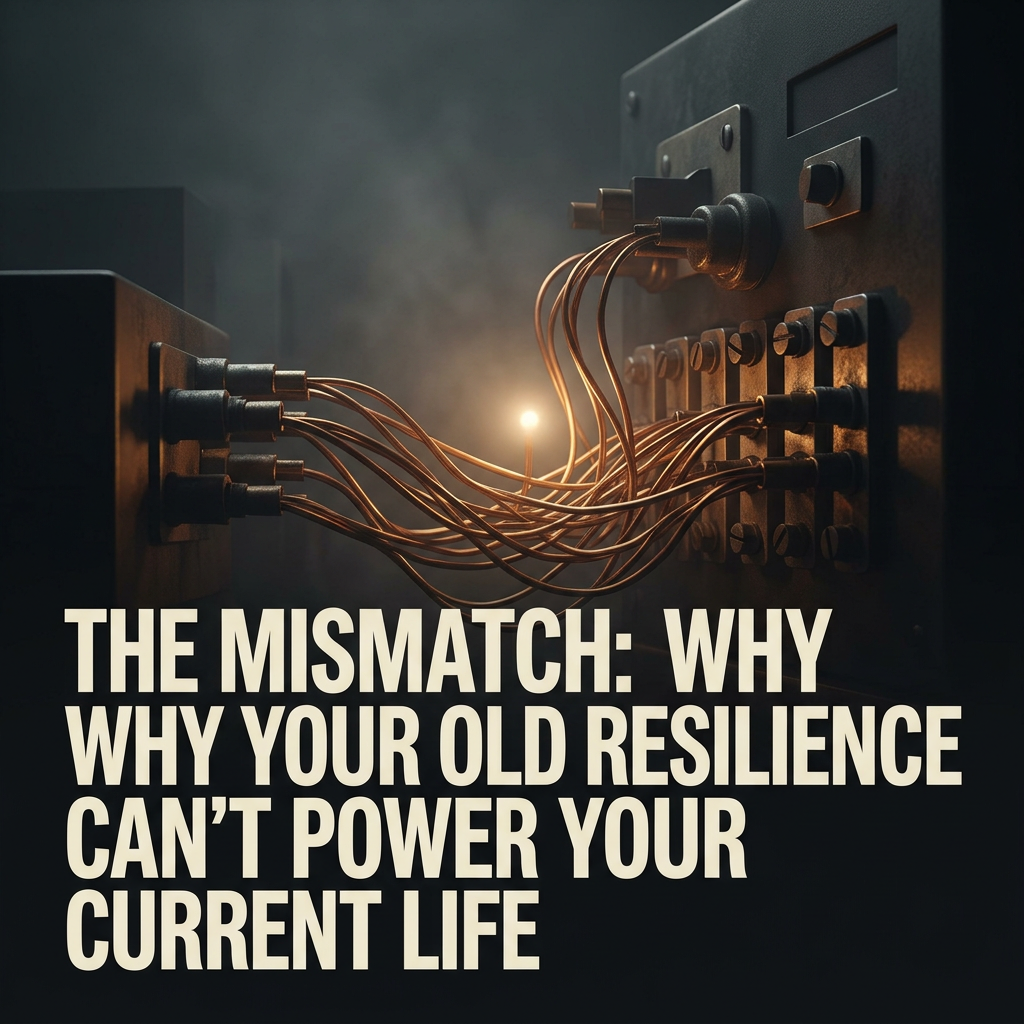
Think of it like this: your internal grid was built for a simple broadcast. But you are now being asked to carry the high-definition, multi-channel current of four or five different lives at once.
We call this "burnout" because it’s the only word we have. But burnout implies you’ve just done too much work. That’s not what this is. You are experiencing a massive mismatch between the current your life is drawing and the capacity of the grid you’re using to carry it.
[PAUSE]
[TRANSITION - Landing Zone]
You don't need a vacation to fix this, and you don't need another productivity app. What you need is to recognize that the rules of the game have fundamentally changed.
The weight you feel isn't just from the number of tasks on your list. It’s from the emotional currency required to hold the people on that list. You are looking for a new way to hold the weight without it crushing the vessel.
What you are feeling is not a failure of your resilience. It is a mismatch between the complexity of your world and the simplicity of the tools you're using to hold it.
[END SCRIPT]